How HiFIT treatment works
A reliable, effective and user-friendly way to improve the fatigue strength of welded structures.
We change the world of welded steel structures
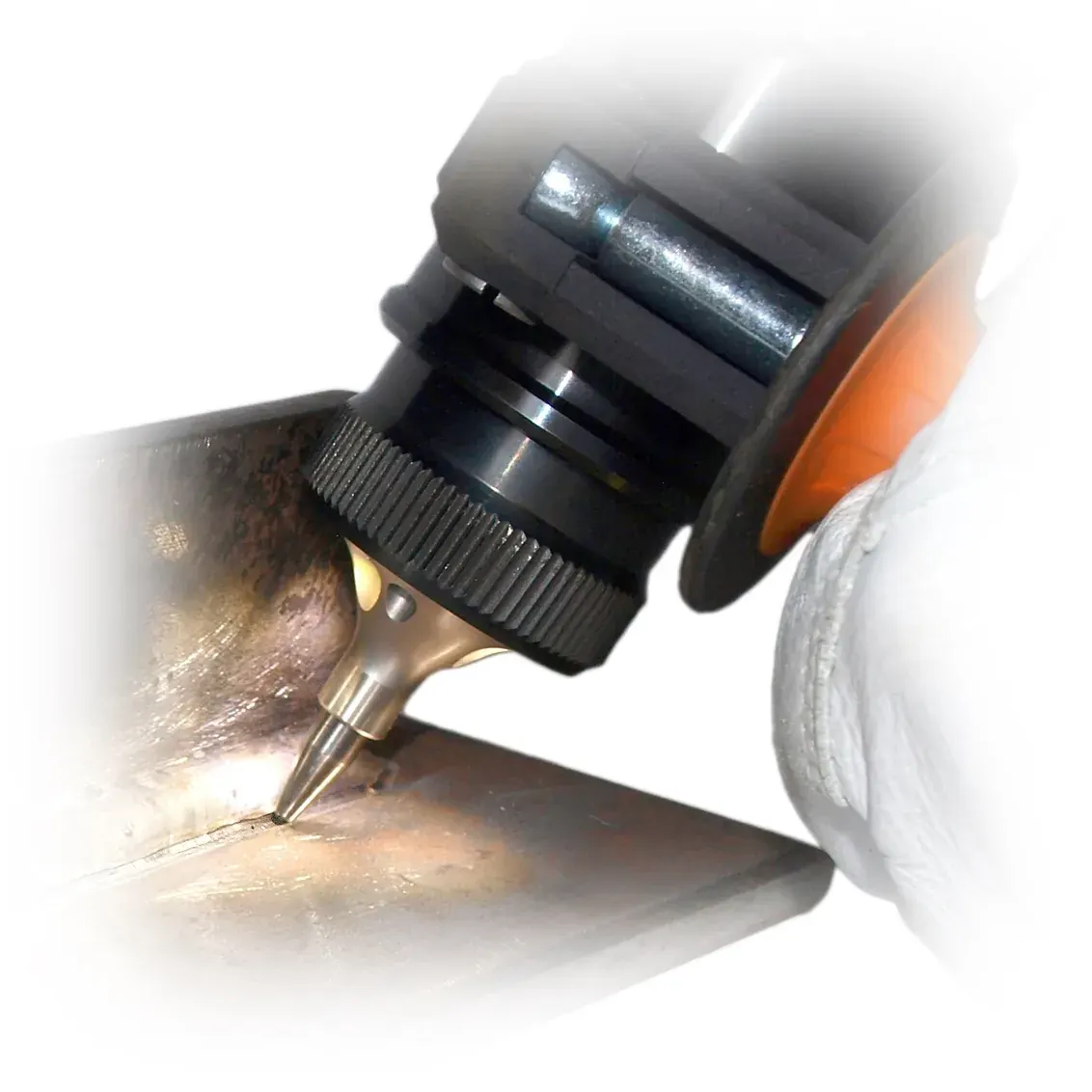
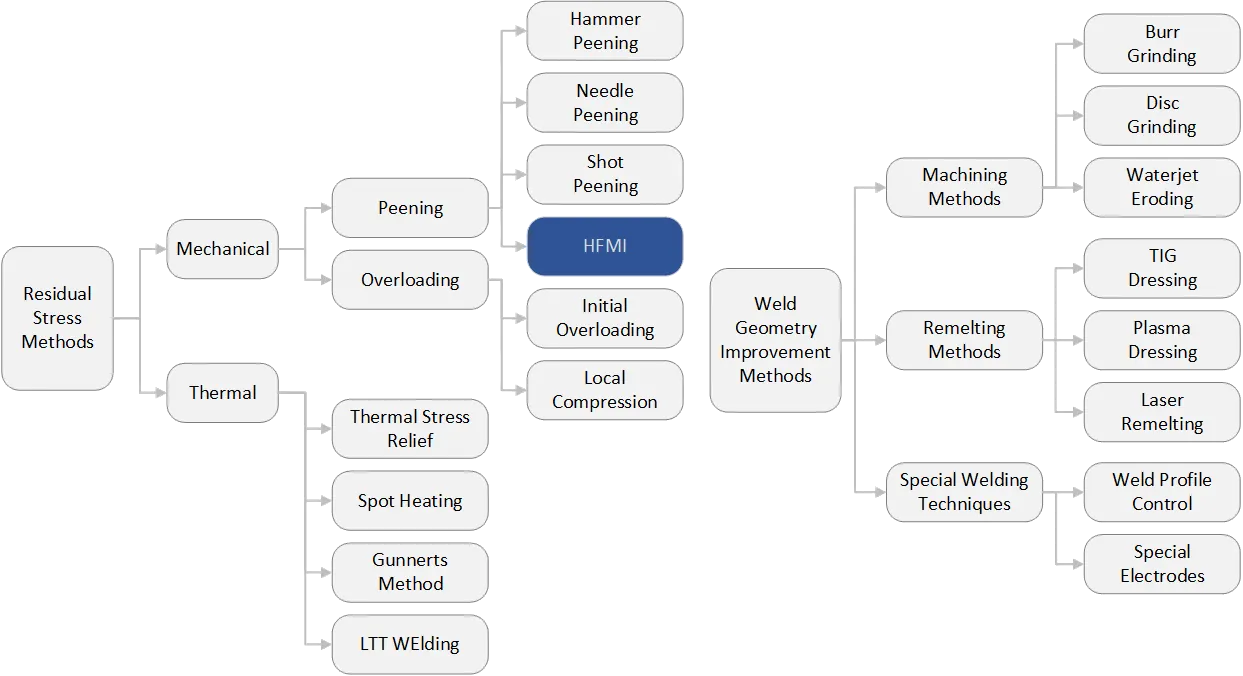
High Frequency Impact Treatment (HiFIT) belongs to a category of post-weld treatment methods called High Frequency Mechanical Impact (HFMI). The treatment modifies the critical regions of welded joints locally.
Beyond reshaping the weld toe, HiFIT introduces high compressive stresses exactly where cracks usually start, which substantially increases fatigue strength. The steel is also cold-worked and hardened by the treatment, which makes it even more resistant to crack initiation and extends the service life of the structure.
HiFIT is a well-established technique that is widely used across many industries. Design rules, workmanship and quality assurance are described in recognized standards and guidelines, such as the IIW recommendations and AASHTO.
Three effects in one treatment
1. Better weld toe geometry
The weld toe is reshaped locally, which removes the sharp stress concentration where fatigue cracks start.
2. Compressive residual stress
The tensile residual stresses of the as-welded condition are replaced by compressive stresses that stop cracks from forming and growing.
3. Surface hardening
Cold work hardens the treated surface and increases its resistance to crack initiation.
Suited for manual and automated application
HiFIT treatment can be applied by hand or automatically. For serial production we have developed a robotic solution that gives precise, efficient treatment at high volumes.
Manual treatment with the handheld HiFIT device.
Sensor-guided automated HiFIT treatment of a weld.
HiFIT in under 3 minutes
A short film about the technology and where it is used.
Frequently asked questions
What is post-weld treatment (PWT)?
Weld toe improvement methods have been studied extensively and have in most cases been proven to significantly improve the fatigue strength of welded details. How well these treatments work depends heavily on the skill of the operator. High Frequency Mechanical Impact (HFMI) has emerged as a reliable, effective and user-friendly method for improving the fatigue strength of welded structures.
The first step towards a longer fatigue life is good design, for example joints with a low stress concentration (such as butt welds instead of fillet welds) and welds placed in low-stress areas. High-quality fabrication also matters: the choice of material, welding process, weld preparation and geometry. If this is not enough to reach the fatigue life target, weld improvement techniques can be applied during or after production.
Post-weld improvement techniques fall into two main groups. Geometry modification methods, such as burr grinding and TIG remelting, remove weld toe flaws and reduce the local stress concentration by creating a smooth transition between the base material and the weld. Residual stress methods, such as hammer peening and needle peening, remove the high tensile residual stress at the weld toe and introduce compressive residual stress instead. They also reduce the stress concentration at the weld toe.
What is HiFIT?
High Frequency Impact Treatment (HiFIT) is one of the HFMI treatment techniques. It improves the fatigue life and strength of welded details through three mechanisms. First, it reshapes the weld toe locally and removes the stress concentration there. Second, it introduces compressive residual stresses in place of the tensile stresses of the as-welded condition. Third, it hardens the surface of the material through cold work.
Targeted HiFIT treatment gives significant improvements in the operational stability and service life of dynamically loaded welded steel structures. The treatment is user-friendly and cost-effective, gives highly reproducible results and allows precise quality assurance.
The HiFIT tools are the result of more than two decades of research and development, carried out in collaboration with DYNATEC Gesellschaft für CAE und Dynamik mbH in Germany.
How much does HiFIT increase fatigue strength?
The fatigue strength of the weld can be increased by 80–100 percent through:
- Local reshaping of the weld toe, which reduces the stress concentration.
- Local hardening of the steel at the treated surface.
- Compressive residual stresses at the weld toe, which prevent cracks from forming and growing at the surface.
How much does HiFIT increase service life?
The service life of welds treated with HiFIT can be extended 5 to 15 times. Many scientific tests in different countries have consistently shown a significant, manifold increase in service life.
Is HiFIT effective on existing steel structures?
Yes, HiFIT is equally effective on existing steel structures. If existing structures are treated in time, there is almost no difference compared with newly treated welds, so their service life is considerably increased. HiFIT is an ideal restoration tool as long as there are no visible cracks.
Can HiFIT be used on high-strength steels?
High-strength steel is becoming increasingly important. Extensive theoretical and experimental analyses of notch details and FEM-supported design show that HFMI treatment becomes more efficient as the tensile strength of fine-grained steels increases, for example S460N, S690QL and steels with even higher strength.
This makes higher-strength steels attractive for lighter structures. The higher the steel grade, the greater the benefit of HiFIT treatment.
Who are we?
HiFIT is a specialized company that provides services and expertise to the steel industry, with a focus on fatigue-loaded steel structures. HiFIT has a strong global presence and extensive experience in post-weld treatment of welded steel structures with HFMI. HiFIT Scandinavia offers the full range of services, from structural analysis to post-weld treatment and quality assurance. This holistic approach lets us deliver optimal, sustainable and cost-effective steel structures.
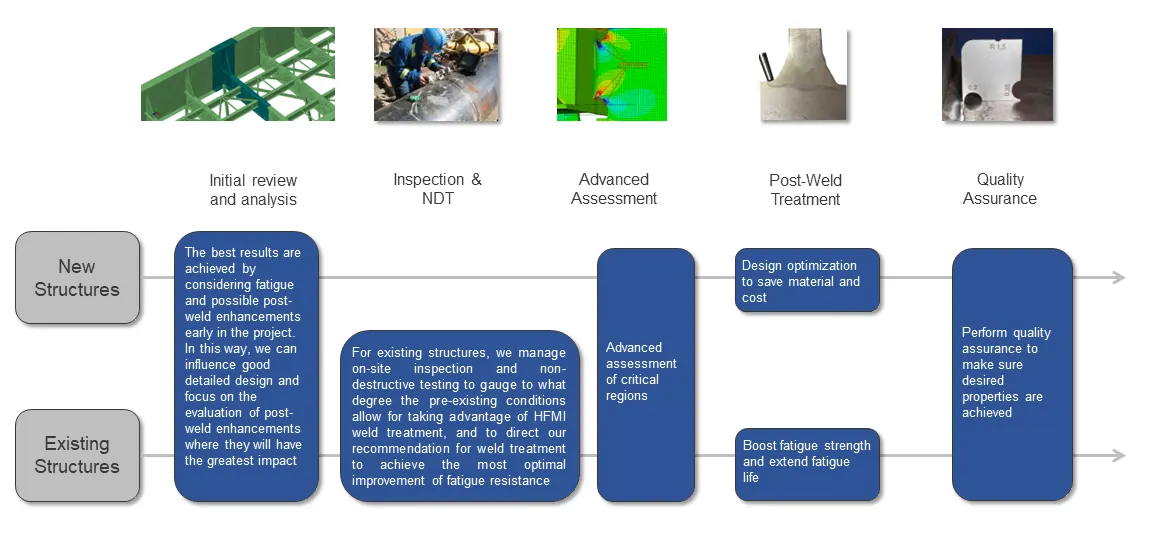
HiFIT methodology